
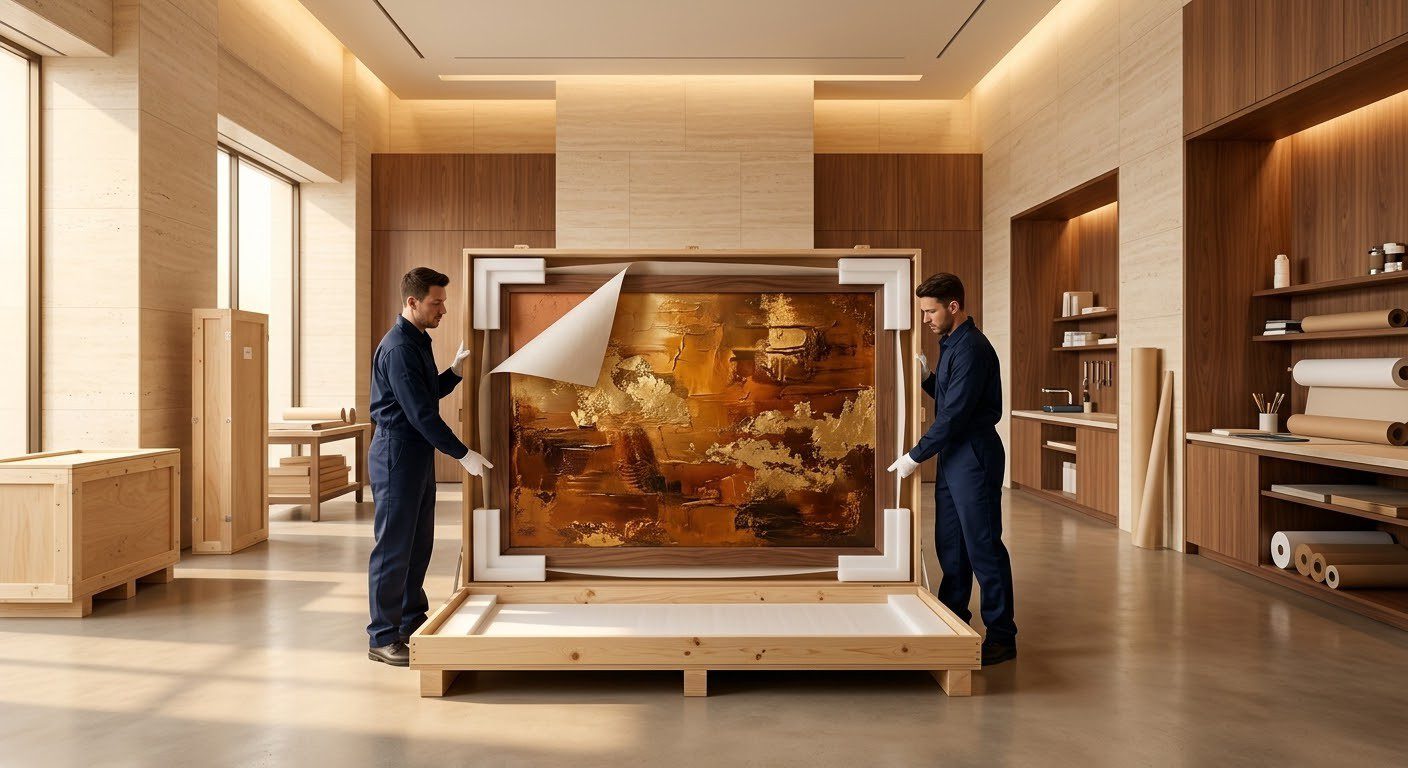
Museum Standards in Art Packaging: Guaranteeing 100% Safety for Heavy and Textured Art During International Shipping
Acquiring a monumental piece of fine art from abroad—perhaps a towering, heavy abstract work or a canvas rich with impasto oil paint—is an exhilarating investment for any American collector or interior designer. However, immediately following the purchase, a critical anxiety sets in: Will it survive the journey?
The fear is not unfounded. International freight involves tumultuous handling, massive changes in humidity and temperature, and the physical stresses of long-haul travel.
For heavy stretchers (which can warp under their own weight) and heavily textured, layered oil paintings (which are prone to cracking if the canvas flexes), standard bubble wrap and a cardboard box are recipes for disaster. To guarantee 100% safety, you must demand Museum Standards of packaging.
Here is a look inside the engineering required to protect investment-grade art during international transit.
The Specific Threats to Heavy and Textured Fine Art
Before understanding the solution, we must understand the mechanics of damage:
- Canvas Flex: For textured oils, the slightest bend in the canvas can cause brittle, thick paint layers to snap or flake off.
- Stretcher Stress: Heavy wooden frames need constant, rigid support. If a crate is dropped or stored improperly, the momentum can twist the frame, loosening the canvas and damaging the corners.
- Climate Shock: An art piece moving from a cool European gallery to a hot cargo hold in Miami, and then to a climate-controlled home in New York, faces extreme shifts. High humidity encourages mold; low humidity makes oil paint incredibly brittle.
The Anatomy of Museum-Standard International Art Packing
Museum-level packing is not about putting art “in a box.” It is about engineering a protective micro-environment. Here are the non-negotiable stages required for high-value, heavy, textured works.
Step 1: The Primary Layer (Conservation-Grade)
The layer that touches the artwork must be chemically inert. We never allow plastic wrap or standard glassine to touch heavy texture or uncured oil paint, as they can stick to or react with the pigments.
- The Standard: We utilize acid-free, archival paper or, preferably, non-abrasive, high-density polyethylene sheets (like Tyvek). These materials prevent scratches, repel water, but remain breathable to allow vapor to escape.
Step 2: The Inner Shadowbox or ‘Float’
A vital standard for textured art is “face-protection.” Nothing must touch the painted surface.
- The Standard: We construct an inner ‘shadowbox’—a rigid, lightweight frame (often acid-free foam board) that surrounds the edges of the painting. The artwork is secured within this frame so that there is a 1-to-2-inch gap between the face of the texture and the outer packaging layer. This creates a cushion of air that protects against punctures or friction.
Step 3: Climate and Moisture Barrier
To mitigate climate shock, the inner package is wrapped in a dedicated moisture-vapor barrier, often utilizing specialized foil wraps.
- The Standard: We seal the inner package with moisture-resistant tape and frequently include silica gel packets calibrated to maintain a stable, ideal Relative Humidity (RH) of roughly 50% inside the wrap, regardless of the conditions outside the crate.
Step 4: The Final Fortress: Custom ISPM-15 Wooden Crates
The outer layer must be rigid, forklift-operable, and certified for international travel.
- The Standard: We engineer a custom, reusable wooden crate using high-quality plywood (not cheap particle board).
- It is strictly reinforced with an internal wooden skeleton to handle heavy weight without collapsing.
- It must bear the ISPM-15 “Wheat Stamp,” signifying the wood is heat-treated to prevent pest infestation, a legal requirement for entry into the United States.
Step 5: Suspension and Shock Absorption
The painting does not simply sit in the wooden box.
The Standard: The inner shadowboxed painting is lined with multiple inches of high-density, closed-cell polyethylene foam (Ethafaom). This is not soft cushion foam; it is dense, shock-absorbent material cut precisely to hold the inner package in suspension. It acts as a shock-absorber, dampening vibrations from airplanes and trucks before they reach the fragile art.
The Human Element: White-Glove Carriers and Fine Art Insurance
Even a perfect crate cannot survive a negligent logistics provider.
When shipping to the US, we never utilize standard parcel carriers for investment-grade art. We partner exclusively with specialised fine-art handlers and white-glove delivery services (like FedEx Art Group or specialized art freight forwarders).
A Note on Fine Art Transit Insurance
Despite museum-standard packing, true security requires legal and financial backup.
- Our Guarantee: Every international shipment is backed by a dedicated, 100% comprehensive transit insurance policy. The valuation is based on the declared purchase price and appraisal.
- Crucially: Museum-standard packing is often a requirement of high-value insurance policies. Using inadequate packing nullifies coverage. Our adherence to these standards guarantees that if the worst happens, your investment is fully protected.
Client Q&A: What You Need to Ask Before Shipping to the US
As a sophisticated buyer, you should interview the gallery regarding their logistics capabilities. Use these questions to ensure your acquisition is handled at a museum standard:
- “Will this piece be custom-crated with face-protection?” (Demand a ‘No-Contact’ packing strategy for textures).
- “Is your wood ISPM-15 certified for US Customs clearance?”
- “Do you provide climate packing for long-haul freight?” (Ask specifically about humidity control and vapor barriers).
- “Are you using specialized fine-art handlers (White-Glove) or a standard parcel service?”
- “Is the insurance policy a comprehensive ‘All-Risk’ fine-art policy for the full value?”
Conclusion
At our gallery, we view the acquisition of a monumental, textured work of art as a lifetime commitment. That commitment extends from the creation of the piece to its safe installation in your home. By adhering strictly to museum standards for engineering, materials, and crating, we eliminate the risks of international shipping and replace anxiety with the seamless experience of owning premium international fine art.